Side Taxi — Your Local Ride in Side
Licensed local taxi and transfer service across Side and Manavgat — fixed fares, clean cars and English-speaking drivers, day and night.
On this page
- Side is three places, and a taxi spends the day between them
- The old quarter, and where a car is allowed to stand
- The hops that come up again and again
- After dark, and the hour before it gets light
- A car you booked, and a car you waved at
- Four, seven or twelve people, and what they are carrying
- When a transfer is the right answer instead
- Popular routes
Need a taxi in Side? We cover the whole resort area — hotel pickups, the old town and harbour, the beaches, and the neighbourhoods of Kumköy, Sorgun, Titreyengöl, Çolaklı and Evrenseki, plus Manavgat centre, its market and the waterfall. We also run fixed-price airport taxi from Antalya (AYT) and Gazipaşa (GZP). One call or WhatsApp message and a driver is on the way.
Why ride with Side Taxi
- A fixed fare agreed before you ride — no meter surprises
- 24/7 dispatch, including late nights and early-morning airport runs
- Clean, air-conditioned cars and vans for families and groups
- Local English-speaking drivers who know every street and hotel
Side is three places, and a taxi spends the day between them
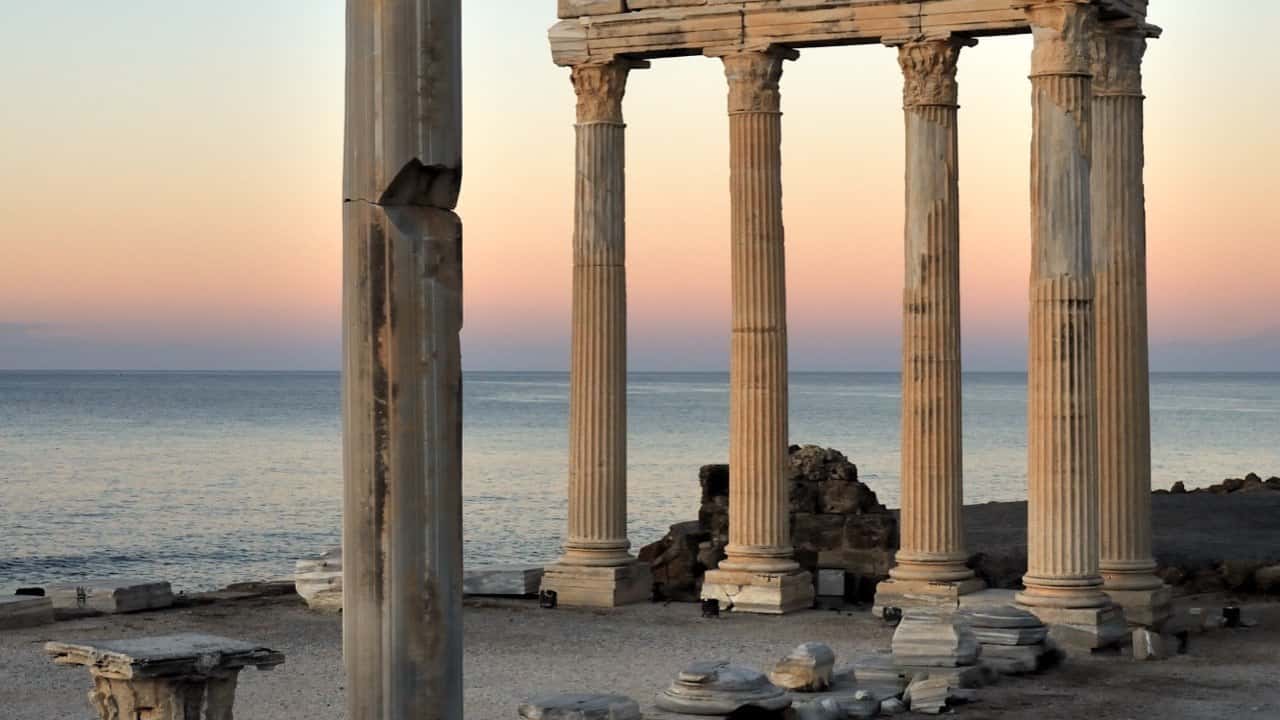
It helps to picture the district as three things rather than one town. The old quarter sits on a low peninsula pushing out into the sea, packed with stone lanes, standing columns, restaurants and small hotels. Behind and beside it run the accommodation strips: the west beach road out past Evrenseki towards Kumköy and Çolaklı, the east beach road towards Sorgun and Titreyengöl. Inland, eight kilometres from the peninsula, sits Manavgat, the district town where the hospital, the banks, the notary, the weekly market and the intercity coaches are.
The airport road figures give you the scale of that arc quickly. Çolaklı is 55 km from Antalya Airport, Kumköy 58, Evrenseki 60, Titreyengöl 64, Side itself 65, Sorgun 66 and Manavgat 72. Read the gaps rather than the numbers: end to end the resort arc is about ten kilometres wide, so a local ride is a matter of minutes rather than an excursion. That is exactly why a taxi earns its place here. The distances are too short for anyone to want to organise a hire car for them, and too long to walk in August with anything in your hands.
Where a passenger is staying changes the job more than where they are going. A guest on a beach road has a driveway, a barrier, a reception door and a car park, and the car pulls up at whichever of those you name. A guest inside the old quarter has none of those things, and the ride ends at a permitted stopping place with a walk after it. Almost everything else on this page follows from that single difference.
The old quarter, and where a car is allowed to stand
The most useful thing a local taxi page can tell you is that the ancient centre is not driven through. The approach past the Roman theatre and the monumental gate was relaid in stone and taken out of general traffic, and a municipal control point now sits at the entrance beside the car park. In season that is enforced, which means an address on the peninsula is reached on foot from the nearest point a vehicle may stand, whatever the pin on your map app suggests.
In practice that point is the open ground at the landward base of the peninsula, by the car park and the coach stand, within sight of the theatre and the museum. Drivers who work this district know it without being told, and it is where local rides set down and pick up all season. There is a second natural stopping place at the far end above the harbour, but whether a vehicle may use it depends on how the area is being managed that year, so treat it as a question to ask rather than a plan to rely on.
The walk from the barrier is short, and it is also real. Much of the approach and many of the lanes are laid in stone, with joints and thresholds that the small hard wheels on cheap cabin cases hate, and the shade along the way in is patchy. Eight minutes on foot at nine in the evening is one of the nicer parts of a holiday; the same eight minutes at three in the afternoon in July, carrying the shopping, is not. Plan the last few hundred metres and the rest of the ride looks after itself.
- Say whether you are inside the old quarter or out on one of the beach roads — the two are different rides.
- If you are inside it, ask your hotel in writing where vehicles may stand for guests and how far its door is from there.
- On a beach road, name the entrance you actually use: reception, the side gate, or the one on the main road.
- Pack so that whoever is carrying the bags can manage a few hundred metres of stone on their own.
The hops that come up again and again
The commonest ride in Side is dinner. A hotel on either beach road out to the entrance of the old quarter in the early evening, then the same run in reverse somewhere between ten and midnight, is the backbone of local taxi work in this district. The second commonest is the harbour end of the peninsula, which people walk out to for the sunset and the temples and then want collecting from, usually a good deal later than they first said.
Then there is Manavgat, eight kilometres inland and about a quarter of an hour away, which is two entirely different rides wearing one name. There is the visitor Manavgat: the waterfall, and the restaurants built out on platforms over the river under the plane trees. And there is the practical one — the hospital and its outpatient clinics, a dentist, a pharmacy that stocks what the hotel shop does not, the banks, the notary, and the weekly market where prices are written for the people who live here. If you are going in for something with an appointment time attached, say so when you book, because the bridge and the market streets slow down at precisely the hours appointments fall.
The rest of the list is short and predictable. The beach clubs along both strips, which are easy to reach in daylight and awkward to leave on foot after dark. The coach station at Manavgat, where the long-distance buses inland depart from. The supermarket run that only looks unnecessary until you try carrying it back. And the move between two hotels halfway through a holiday, which sounds like a taxi job and is usually better booked as a priced leg of its own.
- Hotel to the old-quarter entrance for dinner, with the way back arranged at the same time.
- The harbour end for the evening, and a collection point agreed before you walk in.
- Manavgat for the market, the waterfall, the river restaurants, or an appointment at the hospital.
- A beach club on either strip: out in daylight, back after dark.
- The coach station at Manavgat, for the buses that leave the coast altogether.
After dark, and the hour before it gets light
Side empties and fills at odd hours. Between roughly nine in the evening and one in the morning the whole resort wants to move at once, and that is precisely when the number of cars standing idle is at its lowest: a rank with three cars on it at six has none at eleven, because all three are out doing the dinner run. Later still, in the small hours, there is simply not much about, and nothing about it is unusual for a small coastal district in a hot country.
Which is the argument for settling the return before you go out rather than after you have finished eating. A car booked for half past eleven arrives at half past eleven. A car looked for at half past eleven is a stretch of pavement, a phone with one bar of signal between stone walls, and a conversation about money you did not want to have. The line is open by phone or WhatsApp at any hour, and that is the whole point of it: the booking does not have to be made in office hours, it only has to be made before you need the car.
The same thing runs in reverse before sunrise. An early boat, a long day trip leaving at six, a hospital appointment that wants you there first thing — all of them begin at an hour when nothing at all is passing your hotel gate, and all of them are perfectly ordinary to arrange the evening before.
A car you booked, and a car you waved at
The difference is not the vehicle. It is everything that has been settled before you get in. A booked ride carries a price agreed for the whole car at the moment of booking, and that figure does not move because the coast road was busy, because it is a holiday weekend, or because five of you climbed in rather than two. Nothing is counted up while you travel, so the end of the ride is a door opening rather than an argument on a kerb in the dark.
The other half of it is the address. You give the pickup point and the car comes to it: the hotel gate rather than the main road outside it, the side entrance if that is the one your wing opens onto, the stopping place by the car park if that is where you will be walking out to. A driver who works these streets knows the difference between the gate a hotel prints on its website and the gate its guests actually come out of, which sounds like a detail until you are standing at the wrong one with a table booked for half an hour ago.
And if the plan changes, the booking can be cancelled at no charge, with no cut-off to beat and no notice period to keep. Telling us early is a favour rather than a condition — it lets a driver be somewhere useful instead of outside an empty lobby.
- The price, for the vehicle rather than per head, fixed at the time the booking is made.
- The pickup point, named precisely enough that nobody ends up at a different gate.
- The time, and the return leg too if you already know roughly when you want it.
- A child seat, free on request, whenever somebody small is travelling.
- Cancellation, free whenever you ask, with nothing to forfeit for asking late.
Four, seven or twelve people, and what they are carrying
A short ride hides the vehicle question rather than removing it. Four adults going out to eat want an economy car, which carries four passengers and four cases. A family of six with a folded pushchair does not, and neither do seven friends who have decided to travel together rather than in two cars and meet up at the other end. The classes run economy at four passengers and four bags, standard at seven and seven, first class at six and six, and the minibuses at twelve or sixteen.
Because the price is for the vehicle, a full car costs less per person than a half-empty one, and the arithmetic on a five-minute hop is not the arithmetic of a long drive. On a short run nobody minds being slightly squeezed; a group standing at a gate at midnight minds a great deal whether everyone fits in the car that turned up. So give the headcount when you book rather than when the car arrives, and count the children in it.
Luggage on a local ride is rarely luggage. It is a market haul, a folded buggy, a cool box, beach kit for six, a case being moved between hotels, or a set of clubs going out to a course. Any of those deserves one line in the booking message, because the thing that will not go in is always the thing nobody mentioned. Child seats are provided free on request; send an age rather than asking for a baby seat in general, since a two-year-old and a six-month-old need different things.
- Economy: four passengers, four cases.
- Standard: seven passengers, seven cases.
- First Class: six passengers, six cases.
- Minibus: twelve or sixteen passengers.
When a transfer is the right answer instead
A local taxi is the wrong tool for the airport. Side is 65 km from Antalya Airport and roughly an hour of driving, and along the strips the figures barely differ: 55 km from Çolaklı, 58 from Kumköy, 60 from Evrenseki, 64 from Titreyengöl, 66 from Sorgun and 72 from Manavgat. A leg that long, with a flight at one end of it, wants booking in advance as a transfer at a set price and an agreed meeting arrangement, not settling at a kerb with the clock running. Our Antalya airport taxi page and the Side departure page carry the timings for that in both directions.
The same goes for the long drives. Alanya, Antalya city, Belek, Kemer, Pamukkale and the Muğla coast are journeys rather than hops, and they belong on the intercity route pages, where each one has its own distance, its own duration and its own price per vehicle. A whole day out with the car and driver staying with you is a third thing again and has a page of its own. A move from one hotel to another mid-holiday sits between the two, and is quoted as a leg with the luggage counted in.
None of that is a reason to look elsewhere. It is a reason to book the right thing. Keep this page for what happens inside the district — the dinner run, the market, the waterfall, the beach club, the late collection — and use the transfer pages for anything that leaves it.
- Antalya Airport, in either direction: a fixed-price transfer, on the airport pages.
- Gazipaşa, for flights on the Alanya side: also a transfer rather than a local fare.
- Alanya, Antalya, Belek, Kemer and the longer coast runs: one price per route, per vehicle.
- A full day of sightseeing with the driver staying with you: booked as a car with a driver.
- Changing hotel in the middle of a stay: quoted as its own leg, luggage included.
Side taxi — frequently asked questions
How do I book a taxi in Side?
Call us or send a WhatsApp message with your pickup point and destination. We confirm a fixed price and send a driver straight away.
How much is a taxi in Side?
Local rides are charged at a fixed fare agreed in advance based on distance. Airport taxi from Antalya or Gazipaşa is a fixed per-vehicle price you see before booking.
Do you offer 24/7 taxi service?
Yes. We operate day and night, including early-morning departures and late-night arrivals.
Can I book a taxi from Side to Antalya Airport?
Yes — fixed-price airport taxi and transfer from Side to Antalya (AYT) and Gazipaşa (GZP), with meet & greet for return pickups.
Do you have taxis for groups and luggage?
Yes, vans and minibuses for families and larger groups with plenty of luggage space. Just tell us how many passengers when you book.
Need a taxi in Side now?
Message us your location and destination for an instant fixed fare.