



Antalya Airport to Side Ancient City transfer
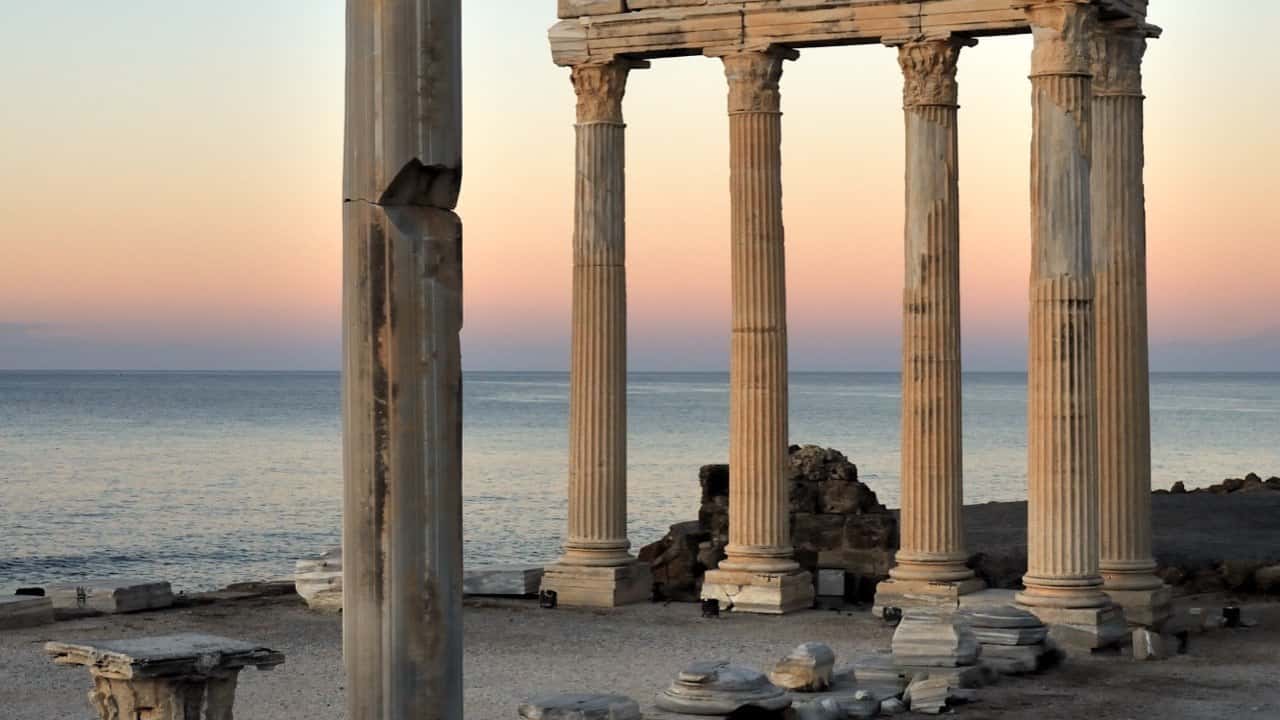
Side Ancient City is not a fenced site you drive to and leave — it is the town itself. The Temple of Apollo stands on the tip of the peninsula, its re-erected columns facing open sea; the Roman theatre and the agora sit at the landward entrance, and a colonnaded street runs between them past shops and restaurants. Ruins, harbour and beach all fall inside one walk, which is why an hour here usually turns into three. In season the old town is closed to through traffic, so every visit is made on foot from the car parks at the neck of the peninsula.
Most people come from a hotel, not an airport. From the Side-area resorts — Kumköy, Evrenseki, Çolaklı, Titreyengöl, Sorgun — it is 10 to 15 minutes, and Manavgat is about the same from the north. Belek and Kadriye are roughly half an hour west, Alanya about an hour east on the D400, Antalya and Lara around an hour. From Kemer you would have to drive back around Antalya, close to two hours each way, too much for one afternoon. A coach hands you a fixed slot in the middle of the day; your own car gives you the temple at sunset and the road home whenever dinner ends.
Going straight from arrivals into the old town does work: 65 km from Antalya Airport, about 60 minutes, and every Side hotel sits within ten minutes of the car parks. Luggage is the catch — the cases stay in the boot while you walk, and check-in is still ahead of you. Most people drop the bags first and come back at six, once the stone has cooled and the lanes have emptied a little.
Visiting Side Ancient City
The visit has no order imposed on it, which is why people miss half of it. Coming in from the car parks you meet the theatre and the arched gateway first, then the street takes you between shopfronts with column stumps standing among the tables, and the temple waits at the very tip of the land, ten minutes further on past the small harbour. Off that line, the lanes on the north shore are half empty and carry more standing masonry than the main street does. The ground is polished marble, patched concrete and high kerbs, and out at the point it turns to loose grit and low walls you step over.
An hour covers the temple and back; three is what the walk actually becomes, because this is a peninsula that does not separate the ruins from dinner. The better half of the day is the second: the marble stays hot and glaring until late afternoon, the point fills for the sunset and empties again straight after, and once it is dark the lanes are lit while the columns are not. The other honest answer is the morning — emptier, kinder to photographs of the theatre wall, and with the shutters still down the ruins stand on their own.
Vehicle access to the old quarter is restricted in the busy season, and that is the one thing worth settling before booking rather than on the day, because where the car can stop decides how far you walk with whatever you are carrying. Assume the drop-off at the neck of the peninsula and treat the pickup as a separate arrangement: nobody comes here for one hour, and a driver held at the edge of a town for four is being paid to stand still. Name a fixed building rather than a street for the return, because after dark the lanes stop looking different from one another.
- With an hour, go straight out to the point for the temple and pick the theatre up on the way back, not the other way around.
- The quarter empties out in the lanes on the north shore, and more stone is left standing there than on the busy street through the middle.
- The shore is a few steps from the ruins, so if you mean to swim you will walk back through the lanes in salt and sand — worth knowing before you dress only for a temple.
- Sunset at the point is the densest ten minutes of the day: stand at its outer edge, or come back twenty minutes later for the same sky with fewer people.