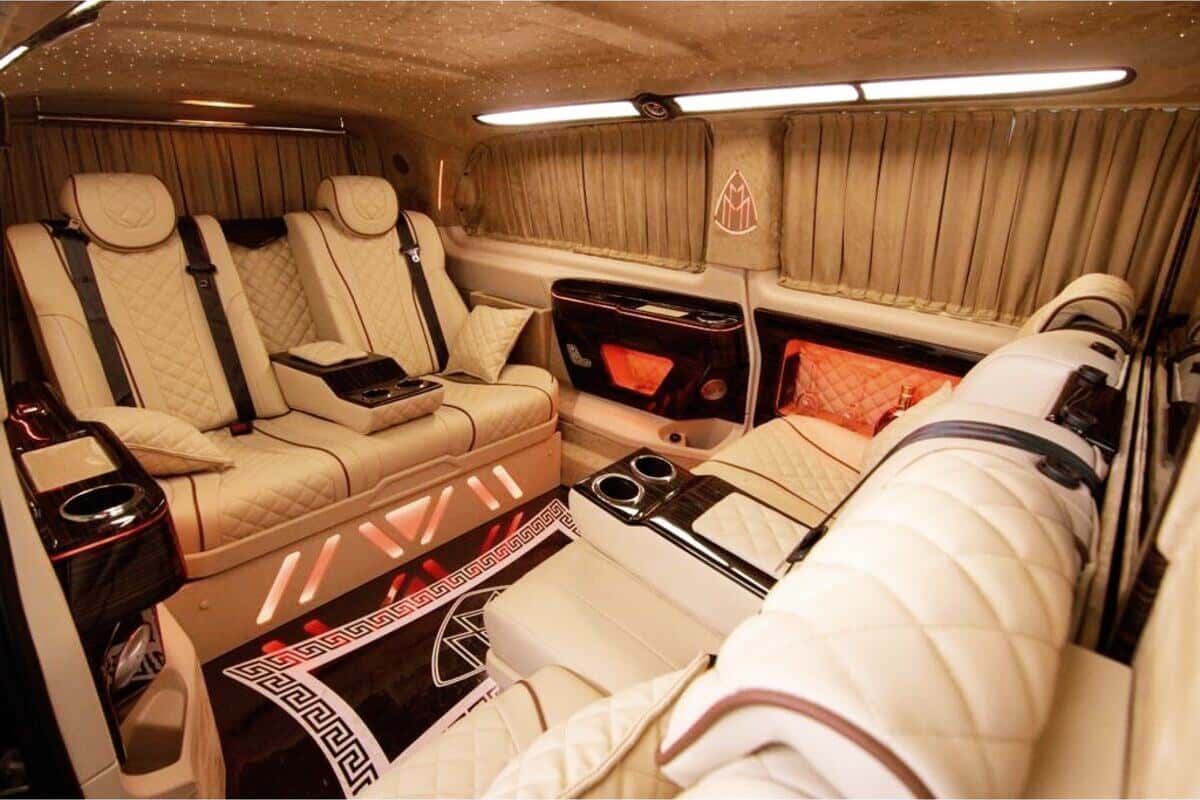
VIP transfer from Antalya Airport: what the First Class Van adds
What a VIP transfer from Antalya Airport really buys: the First Class Van, 6 passengers and 6 cases, a fixed step above Economy — and when it is not worth it.
On this page
- VIP here is a vehicle class, not a different service
- Who books it, and what they are really buying
- Economy, Standard, First Class: the numbers side by side
- When the space matters more than the badge
- When it is honestly not worth it
- Booking it: what to state
- What happens on the day
- Popular routes
- Frequently asked questions
Search for a VIP transfer and you will be promised an experience. Here is the plainer version. On this site VIP is a vehicle class, not a different service: the name sign in arrivals, the tracked flight number, the private run with nobody else in the car and the price fixed at booking all come with every booking, including the cheapest one. What the First Class Van adds is the car itself.
That makes the decision simpler than the word suggests. You are not buying a better arrangement, you are buying more room — six passengers, six suitcases — at a fixed step above the Economy fare for the same route. This page sets out who that is worth it for, what it is measured against, and the cases where the extra step buys you almost nothing.
VIP here is a vehicle class, not a different service
Every transfer booked through this site is private and direct: no other passengers collected on the way and no round of other hotels before yours. The driver waits inside the arrivals hall holding a printed name sign. Your flight number is tracked, so a late landing moves the pickup rather than costing you the fare. The fare is per vehicle, in euro, fixed the moment you book. None of that is an upgrade. It is the service, in the Economy Van as much as in the First Class Van.
So when the booking form offers you First Class, it is offering a vehicle and not a tier of treatment. Less exciting than the sentences the word VIP usually appears in, and the only one that still holds at half past eleven at night in a hotel driveway. It also means you can stop weighing up things that are not on offer: where the driver stands, what the sign says and what to do if you miss each other are identical in all four classes, and our meet and greet page covers them in full.
- In every class: the name sign in arrivals, the tracked flight, the private direct run, the fixed per-vehicle price, child seats on request.
- What First Class changes: the vehicle, and how much room each passenger and each case has inside it.
- What it does not change: the route, the traffic, the arrivals hall, or your place in the passport queue.
Who books it, and what they are really buying
A business arrival is the clearest case. Someone lands at eight in the morning with a laptop bag and a suit carrier, has a meeting in Antalya before lunch, and wants the drive in between to be usable rather than endured: room to sit properly, a bag that is not on a lap, one quiet run to the door. That is a vehicle question, and it has a vehicle answer.
Then the couples marking something — an anniversary, a honeymoon, a first trip back after years of not travelling. For them the upgrade is the first thing that happens on the holiday, which gives a modest fixed supplement a weight out of all proportion to its size. Nobody needs to justify that on luggage grounds.
The third group is the least glamorous and much the largest: four adults who would rather not sit shoulder to shoulder for an hour. Four passengers with four cases are exactly what the Economy Van is rated for, which means it fits and it is full. Moving up buys the slack. Guests of the five-star houses along Lara and Belek book it for a related reason — if the hotel was chosen carefully, it is odd to leave the hour before it to chance.
Economy, Standard, First Class: the numbers side by side
The classes are rated by passengers and cases together, and the ratings are worth reading before the names. The Economy Van takes 4 passengers with 4 suitcases. The Standard Van takes 7 and 7. The First Class Van takes 6 and 6. The Minibus takes 12, or 16 in the larger vehicle. Read that list twice and the odd one out is obvious: First Class sits above Standard in price and below it in headcount.
That is not an error in the list. The Standard Van exists to get seven people and seven cases down the coast; the First Class Van gives comparable space to six, which is precisely the thing being sold. If your party is seven, First Class is not an option and the question never arises. Six or fewer, and it is the top of the range.
The step between classes is a flat supplement over the Economy fare for your route, published on the price list rather than negotiated, and it is the same supplement whether the drive is twenty minutes or two hours. That one fact settles more of these decisions than anything written about comfort, and it points somewhere most people do not expect: the upgrade is at its most generous on the long routes and at its thinnest on the short ones.
- Economy Van: 4 passengers, 4 suitcases.
- Standard Van: 7 passengers, 7 suitcases — more seats than First Class, not fewer.
- First Class Van: 6 passengers, 6 suitcases.
- Minibus: 12 passengers, or 16 in the larger vehicle.
- Every class sits a fixed step above the Economy fare for the same route: a flat amount, not a percentage.
When the space matters more than the badge
Distance is the first test, because a flat supplement spread over a long drive is the best arithmetic on this page. Alanya is 125 km from the terminal, about 105 minutes. Kaş is 190 km, comfortably over two and a half hours. On journeys of that length the gap between adequate room and generous room is felt for the whole of it, while the supplement has not moved for the extra hour.
Luggage is the second test. The ratings run at roughly one case per seat, so a party that breaks the ratio has a vehicle problem rather than a comfort preference: three adults with five large cases are a six-bag booking, not a four-bag one. Golf bags are the extreme version, since a set in a hard case takes the room of two suitcases and stops the rest stacking — which is why two golfers bound for Belek at 35 km or Kadriye at 30 km end up in a vehicle their headcount would never suggest.
Third, the awkward middle. Three or four adults is exactly where Economy is technically sufficient and practically tight. A full Economy Van has no spare seat for coats, cameras and duty free, so whatever misses the boot travels on somebody’s knees. Six rated places for four people solves that without booking a minibus nobody needs.
- Long runs: Side at 65 km, Alanya at 125 km, Kaş at 190 km — the flat supplement covers more hours the further you go.
- More cases than seats: golf bags, a pushchair, a month of clothes for two children.
- Three or four adults who would rather not be shoulder to shoulder for an hour.
- An early meeting, where the drive has to be usable rather than merely survivable.
When it is honestly not worth it
Two people with cabin bags going to Lara should book the Economy Van. Lara is 15 km from the terminal, roughly twenty minutes; there is not enough journey there for a larger vehicle to give you anything. The same holds for Kundu at 15 km and the Antalya city centre at 13 km. You would pay a fixed supplement for twenty minutes of slightly more space and arrive at the same moment, met by the same driver holding the same sign.
It is not worth it for speed either, and that misconception deserves killing outright. The coast road is one road. A First Class Van sits in the same August traffic as everything else on it, leaves the airport by the same exit and arrives when it arrives. There is no lane, no priority and no shortcut attached to the class, and any page hinting otherwise is selling something it cannot deliver on a Saturday afternoon.
Nor is it the answer to a capacity problem. Seven passengers need the Standard Van and nine need a minibus; buying further up the price list does not buy seats, because First Class carries six. If the question is how to fit everyone in, the class you want is the one with the right number beside it, and our minibus and group transfer page does that arithmetic properly.
- A short hop — Lara, Kundu, the city centre — where twenty minutes does not repay a supplement.
- Any hope of a faster journey: the traffic is the traffic in every class.
- Seven or more passengers: you need the Standard Van or a minibus, whatever the price list suggests.
Booking it: what to state
Booking a First Class Van is the ordinary booking with the class named. What goes wrong is silence — a request for a VIP transfer with no class, no bag count and no hotel name has to be guessed at, and a guess made in an office is worth less than one line from the person who packed the cases. Name the class as it appears on the price list rather than by adjective: VIP, luxury and premium mean different things on different websites, while First Class Van means one specific vehicle here.
Give the flight number rather than the airline and the time, because the number is what is tracked and what tells us which terminal to stand in. Round trips are arranged on the same booking, and the return leg keeps the class you chose unless you say otherwise; plenty of people book First Class out of the airport and Economy back to it, which is a sensible way to spend the difference. Child seats are on request in this class as in every other, asked for at booking with each child’s age and weight.
- The vehicle class by name: First Class Van.
- Passengers and large suitcases as two separate numbers.
- The flight number, plus the terminal if your own booking names one.
- The full hotel name and the resort, because access differs more than distance does.
- Child seats with an age and a weight for each child, and whether you want the return leg quoted now.
What happens on the day
Nothing about arriving in a First Class Van is different, which is the point of everything above. The flight is tracked, so nobody has to call from the aircraft. The driver is in the public arrivals hall with the printed sign, where every meeting on this site happens, and the car stands in the car park rather than at the kerb, because kerbside stopping in front of arrivals is controlled. Our meet and greet page covers that walk and what to do if the two of you miss each other; it applies here unchanged.
From there it is your vehicle for the whole run, with no other passengers and no collection round, to the hotel door wherever the hotel’s own access allows a van to reach it. The fare was fixed when you booked and does not move for a delayed landing, a long queue at passport control or an afternoon on the Alanya road. WhatsApp and phone are answered day and night, which matters most for the arrivals that land at three in the morning.
If you are unsure whether the class earns its money on your particular route, ask before you book rather than afterwards. Send the number of people, the number of large cases and where you are going. Sometimes the answer is that the Economy Van is the right vehicle for you, and we would rather say so than sell an upgrade you would not notice.
Frequently asked questions
What do I actually get with a VIP transfer?
The First Class Van — a larger vehicle rated for 6 passengers and 6 suitcases — rather than a different service. The name sign in arrivals, the tracked flight, the private direct run and the fixed per-vehicle price are included in every class, so what the VIP fare buys is the room inside the car.
Is the VIP van bigger than the standard van?
It has more room per passenger but fewer seats. The Standard Van is rated for 7 passengers and 7 cases, the First Class Van for 6 and 6. That is deliberate: the same kind of space is given to six people instead of seven. For a party of seven, First Class is not an option.
How much more does a First Class Van cost?
It sits a fixed step above the Economy fare for your route, shown on the price list rather than quoted route by route. The step is a flat amount, not a percentage, and it is identical on a twenty-minute run and a two-hour one — which is why the upgrade stretches furthest on the long routes.
Will a VIP transfer get me there faster?
No. Every class uses the same coast road, the same airport exit and the same traffic, so the journey time is set by the route and the hour, not by the vehicle. There is no priority lane and no shortcut attached to the class. What you gain is comfort for the same number of minutes.
Is it worth booking VIP for a short transfer to Lara?
Usually not. Lara is about 15 km and twenty minutes from the terminal, and two people with cabin bags will barely notice the difference before they arrive. Keep the Economy Van for the short hops around Lara, Kundu and the city centre, and spend the supplement on a long run if you have one.
Can six people with six suitcases really travel in one First Class Van?
That is what the class is rated for, and the rating is roughly one case per seat. What it will not absorb is more luggage than seats: six people with ten large cases are a minibus, because empty seats do not become luggage space. Send both numbers and we will confirm before you book.
Can I book the First Class Van for the return leg as well?
Yes, and it is arranged on the same booking, which is also how the return time gets set from your departure. The return keeps the class you chose unless you ask for something else, and mixing them is common: First Class into the resort, Economy back to the airport.
Are there child seats in the First Class Van?
On request, as in every class, and settled at booking rather than at the airport. One point specific to this class: a fitted seat occupies one of the six places, so a party of six travelling with a toddler is really planning around five adult seats. Send us the age and weight of each child and we will confirm what can be fitted on your date.